Quick answer: A tachymeter is a scale printed on the bezel or outer edge of the dial of a chronograph watch. It converts the number of seconds something takes to cover a known distance into its speed per hour. Start the chronograph at the beginning of a measured kilometre or mile, then stop it at the end. Read the tachymeter number next to where the seconds hand stopped. That number is your speed in km/h or mph. The scale is based on one simple formula: average speed = 3,600 × distance ÷ elapsed seconds. For exactly one kilometre or mile, this becomes 3,600 ÷ seconds.
That ring of numbers around many sporty watches isn’t just decoration. It’s a clever, low-tech calculator that’s been used by racing drivers, engineers and watch fans for decades. Once you understand the idea, you can use it in about ten seconds.
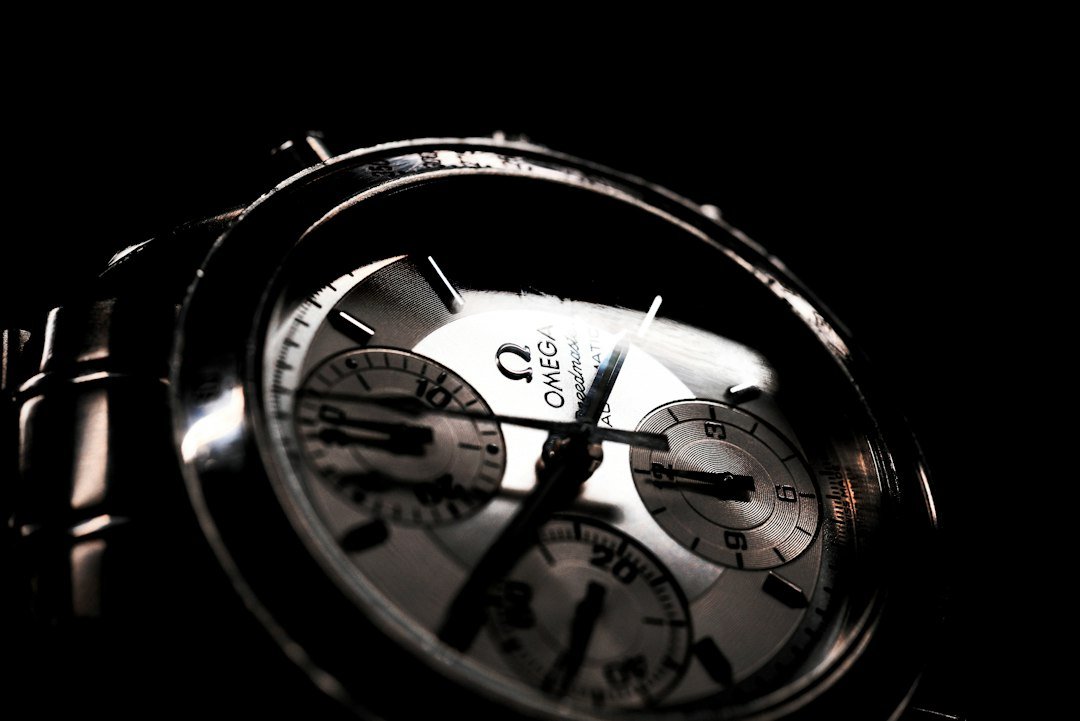
What Is a Tachymeter?
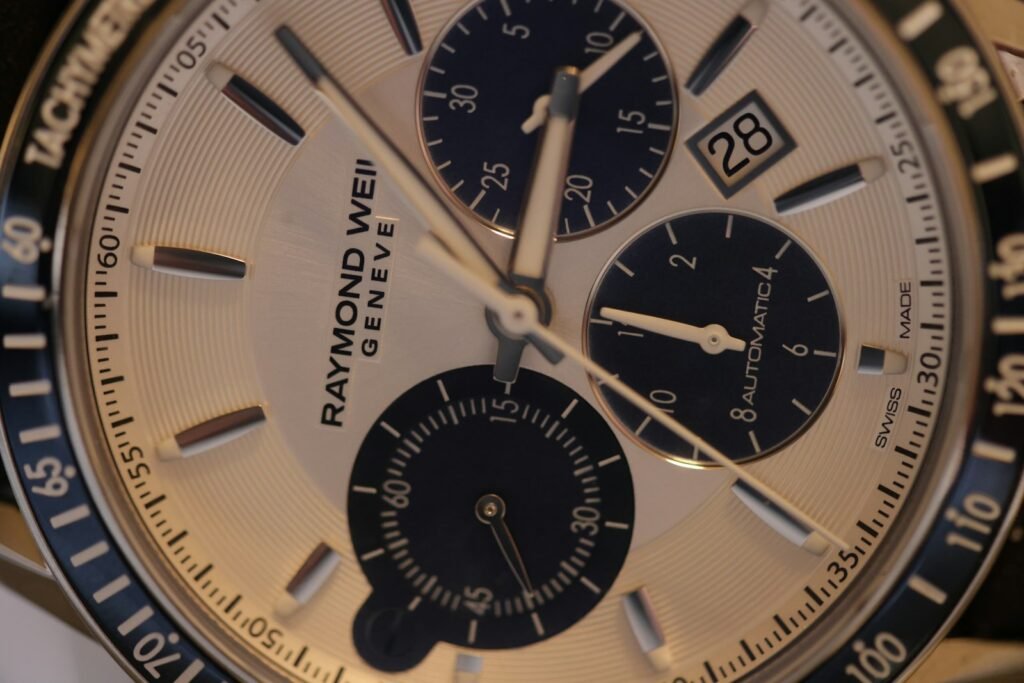
The word comes from the Greek tachy (fast) and metron (measure). On a watch, the tachymeter is a scale around the bezel or dial edge, usually marked “TACHYMETER” or “TACHYMETRE”. It works together with the chronograph, the watch’s stopwatch function, so you will usually find it on chronographs.
It’s important to know what a tachymeter is not:
- It isn’t a speedometer and can’t measure speed on its own. You need a known distance and a timed start and stop.
- Nor is it a pulsometer, a different scale used to measure heart rate.
- It doesn’t make the watch more accurate. The watch’s accuracy comes from its movement, whether quartz or mechanical.
How Does a Tachymeter Work?

There are 3,600 seconds in an hour. If something takes t seconds to travel one unit of distance, it travels 3,600 ÷ t units per hour. The scale simply prints the answer next to each second, so you don’t have to do the maths.
| Seconds to cover 1 unit | Tachymeter reading (units per hour) |
|---|---|
| 10 seconds | 360 |
| 15 seconds | 240 |
| 20 seconds | 180 |
| 30 seconds | 120 |
| 40 seconds | 90 |
| 45 seconds | 80 |
| 60 seconds | 60 |
The “unit” can be anything: kilometres, miles, laps or even products on an assembly line. Whatever you count, the scale works the same way.
How to use a tachymeter step by step

Measuring speed
- Find a known distance, such as the gap between two kilometre or mile markers on a highway.
- Reset the chronograph so the seconds hand is at 12.
- Start the chronograph as you pass the first marker.
- Stop it as you pass the second marker.
- Read the tachymeter scale next to the chronograph seconds hand. That’s your average speed.
Example: you pass two kilometre markers 30 seconds apart. The hand stops at 30 seconds, next to 120 on the scale. Your average speed was 120 km/h.
Safety note: if you’re the driver, keep your eyes on the road. Let a passenger do the timing.
Seconds to speed at a glance
The scale divides 3,600 by the seconds you timed. These are the readings over one kilometre or one mile.
| Time over 1 km or 1 mile | Tachymeter reading |
|---|---|
| 20 seconds | 180 km/h or mph |
| 30 seconds | 120 km/h or mph |
| 36 seconds | 100 km/h or mph |
| 40 seconds | 90 km/h or mph |
| 45 seconds | 80 km/h or mph |
| 60 seconds | 60 km/h or mph |
Measuring over a different distance
If your distance isn’t exactly one unit, multiply the reading by the distance. For example, over half a kilometre in 24 seconds, the scale shows 150. Multiply by 0.5 and you get 75 km/h.
Measuring production or work rate
Time how long it takes to complete one task. If packing one box takes 15 seconds, the tachymeter shows 240, meaning a rate of 240 boxes per hour.
Measuring distance from a known speed
You can also use the scale in reverse. Say you’re travelling at a steady 90 km/h. Start the chronograph and wait until the seconds hand reaches 90 on the tachymeter scale (40 seconds). At that point, you’ve travelled one kilometre.
Where a tachymeter stops being useful
- Check the scale’s range. A conventional single-turn scale ends at 60 seconds; its upper rate varies by watch. For a longer interval, use the total elapsed seconds in the formula rather than reading the seconds hand alone. Some specialist scales have a different layout.
- It gives average speed over the measured distance, not your speed at any one moment.
- You need an accurate, known distance. Errors in distance or reaction time affect the result.
- The scale gets cramped at high speeds. Above about 200, small timing errors make a bigger difference.
Where the tachymeter bezel came from
Tachymeter scales became popular on chronographs in the mid-20th century, especially with motor racing. Several watches made the tachymeter bezel famous:
- Omega Speedmaster: launched in 1957, it was among the first chronographs with a tachymeter on the bezel, not the dial. NASA qualified it for spaceflight in 1965. It reached the Moon in 1969, earning its nickname, the “Moonwatch”.
- TAG Heuer (Heuer) Carrera: introduced in 1963 and named after the Carrera Panamericana road race.
- Rolex Cosmograph Daytona: launched in 1963, with its tachymeter bezel tied to the Daytona racing scene.
Today, tachymeter chronographs come in every price range, from affordable Seiko, Citizen, Casio Edifice and Timex models to luxury pieces. Many are quartz or solar-powered, and others are mechanical. If you like low-maintenance watches, read our guide to what a solar watch is.
Tachymeter vs Other Watch Scales
| Scale | What it measures |
|---|---|
| Tachymeter | Speed or rate per hour from elapsed seconds |
| Pulsometer | Heart rate from a set number of beats |
| Telemeter | Distance to an event using the speed of sound (for example, thunder after lightning) |
| Dive bezel | Elapsed time, usually up to 60 minutes |
| GMT bezel | A second time zone in 24-hour format |
How to Choose a Tachymeter Watch
- Bezel or dial scale: a bezel scale is bolder and easier to read. A dial scale gives a different layout, but does not determine case thickness.
- Movement: quartz and solar chronographs are accurate and affordable. Mechanical chronographs are prized for craftsmanship.
- Legibility: look for clear contrast between the scale, hands and dial.
- Size: chronographs tend to be larger. Try it on if possible: case diameter, thickness and lug-to-lug length all affect fit.
- Style: racing chronographs pair well with casual and smart casual outfits. See our classy casual outfit guide for ideas.
How to look after a chronograph
- Don’t press the chronograph pushers underwater unless the manufacturer says it’s safe.
- Check the water resistance rating before swimming.
- Have mechanical chronographs serviced at the intervals the brand recommends.
- Wipe the case and bracelet with a soft, slightly damp cloth, and keep the watch away from strong magnets.
Questions people ask about tachymeters
What is the purpose of a tachymeter on a watch?
It turns the seconds taken to cover a known distance into speed, or any rate per hour. You get the answer without doing any maths.
Can a tachymeter measure heart rate?
No, that’s the job of a pulsometer scale, which some chronographs have instead of, or as well as, a tachymeter.
Does a tachymeter work in miles and kilometres?
Yes, because the scale has no fixed unit. If you time one mile, the reading is in mph; if you time one kilometre, it’s in km/h.
Why does the tachymeter scale stop at 60?
On a conventional single-turn scale, 60 seconds corresponds to 60 units per hour. For longer timings, calculate using the total elapsed seconds. Specialist multi-turn scales may work differently.
Do you need a tachymeter on a watch?
Most people rarely use it in daily life. It’s mainly a design feature with a fun practical side, but it’s genuinely useful once you learn how.
Do all chronographs have a tachymeter?
No, some chronographs have no scale at all, while others use pulsometer, telemeter or decimal scales instead.
What does tachymeter mean?
The word comes from Greek words for speed (tachos) and measure (metron). On a watch, it is the scale that turns elapsed seconds into a speed.
Try the 30-second example
A tachymeter is one of watchmaking’s simplest and smartest tools: start, stop, read. Remember the formula, 3,600 divided by seconds, and the scale will make sense. Use it to time a lap, a train between stations or how quickly you can pack a box.